
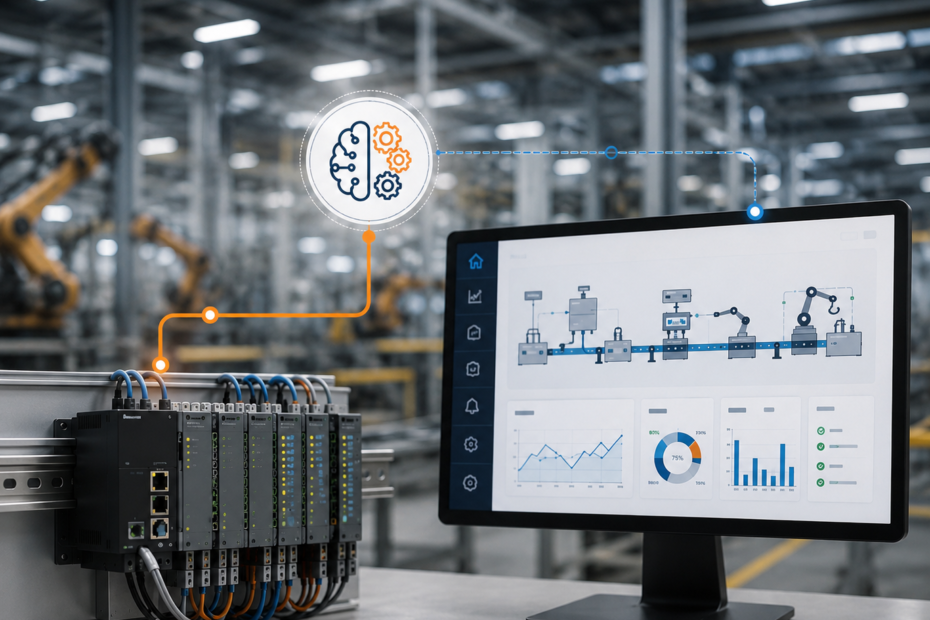
If you’ve searched for PLC SCADA, you’ve probably come across countless articles repeating the same line:
“PLC is hardware, SCADA is software.”
Technically correct—but practically incomplete.
That explanation doesn’t tell you why factories need both systems, why they’re often mistaken as competitors, or how they actually work together in industrial automation. So instead of repeating textbook definitions, let’s look at how PLC and SCADA behave in a real industrial environment.
PLC and SCADA Explained: Hands vs. Brain
Imagine a large manufacturing plant—a bottling line, a steel mill, or a water treatment facility.
On the factory floor, machines constantly react to sensor inputs by opening valves, starting motors, or stopping conveyors within milliseconds. That instant response is the job of the PLC (Programmable Logic Controller). Think of it as the plant’s hands and reflexes—fast, reliable, and focused entirely on executing control logic.
Now picture a control room where operators monitor production, tank levels, alarms, and performance trends across an entire facility.
That’s SCADA (Supervisory Control and Data Acquisition).
SCADA acts as the plant’s brain and eyes. It doesn’t directly control machinery; instead, it collects information, displays it visually, records historical data, and helps operators make informed decisions.
Hands don’t need to see the whole factory to do their job.
A brain doesn’t need to physically move a valve—it only needs to know the valve moved.
That’s why PLC and SCADA aren’t competing technologies—they’re complementary parts of the same automation system.

PLC vs SCADA: Key Differences
| Aspect | PLC | SCADA |
|---|---|---|
| Nature | Hardware controller | Monitoring & supervisory software |
| Speed | Millisecond response | Near real-time monitoring |
| Function | Executes control logic | Visualizes, logs, and supervises data |
| Scope | Individual machine/process | Entire plant or multiple sites |
| Failure Impact | Machine stops | Monitoring is lost, but PLC usually keeps running |
One of the biggest misconceptions is what happens if SCADA fails.
In a properly designed system, production usually continues because the PLC keeps executing its programmed logic. Operators may temporarily lose dashboards and alarms, but the machine itself doesn’t immediately stop.
3 Common Myths About PLC and SCADA
Myth 1: SCADA controls the machines.
Not directly.
SCADA sends supervisory commands, but the PLC executes the actual control logic.
Myth 2: You need SCADA for automation.
False.
A PLC can fully automate a machine without SCADA. SCADA simply adds centralized monitoring, alarms, historical data, and reporting.
Myth 3: PLC and SCADA are competitors.
They aren’t alternatives.
PLCs handle machine control, while SCADA provides visibility and supervision. Most industrial automation projects use both together.
How PLC and SCADA Work Together
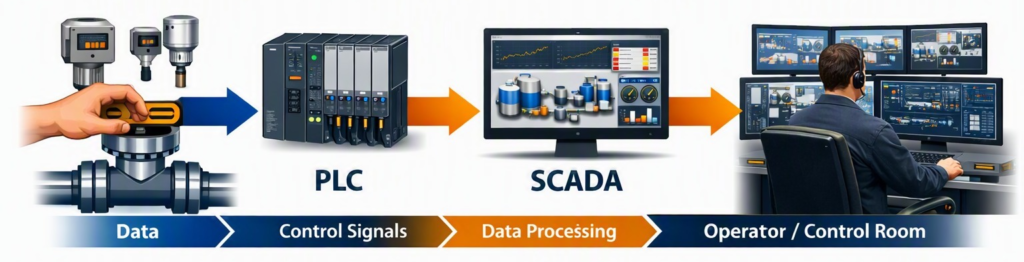
A typical PLC SCADA system follows a simple workflow:
- Sensors collect real-time process data.
- The PLC processes that information and controls machines instantly.
- SCADA receives the PLC data, displays it to operators, logs historical records, and generates alarms.
- Operators monitor the process and make supervisory decisions when required.
This layered architecture is the foundation of modern industrial automation.
Which One Do You Actually Need?
If you’re automating a single machine that requires instant responses, you need a PLC.
If you need centralized monitoring, historical data, alarms, reporting, or remote supervision across multiple machines, you need SCADA.
For most manufacturing facilities, the answer isn’t PLC or SCADA.
It’s PLC and SCADA working together.
Final Takeaway
PLC SCADA isn’t a comparison of competitors—it’s a partnership that powers modern industrial automation. The PLC handles execution, while SCADA provides visibility and supervision. Together, they create automation systems that are faster, smarter, and more reliable. Understanding this relationship is the key to designing efficient and scalable industrial control systems.
Need Help Designing Your Industrial Automation System?
Puja Controls specializes in custom industrial automation, PLC SCADA integration, and test & measurement solutions tailored to your application. If you’re planning your next automation project, our team can help you design a solution that fits your operational requirements.
Get in Touch with Our Automation Experts →www.pujacontrols.com
Frequently Asked Questions (FAQs) About PLC SCADA
The main difference lies in their role. A PLC (Programmable Logic Controller) executes real-time control logic at the machine level, while SCADA (Supervisory Control and Data Acquisition) monitors, visualizes, and records data across the entire system. In simple terms, the PLC acts, while SCADA observes and supervises.
Yes. A PLC can independently automate and control a machine or process without SCADA. SCADA is not mandatory—it adds centralized monitoring, alarm management, historical data logging, reporting, and remote visibility, making it valuable for larger industrial operations.
In a well-designed PLC and SCADA system, production usually continues even if SCADA goes offline. The PLC continues executing its programmed logic independently, while operators temporarily lose dashboards, alarms, and real-time monitoring until the SCADA connection is restored.
Both are important, but they serve different purposes. A PLC is essential for controlling machines and executing automation logic, while SCADA becomes essential when centralized monitoring, historical data, alarms, and supervisory control are required across multiple machines or an entire plant.
PLC SCADA systems commonly use industrial communication protocols such as Modbus, OPC UA, EtherNet/IP, PROFINET, Profibus, and EtherCAT. The choice of protocol depends on the PLC, SCADA software, network architecture, and application requirements.