
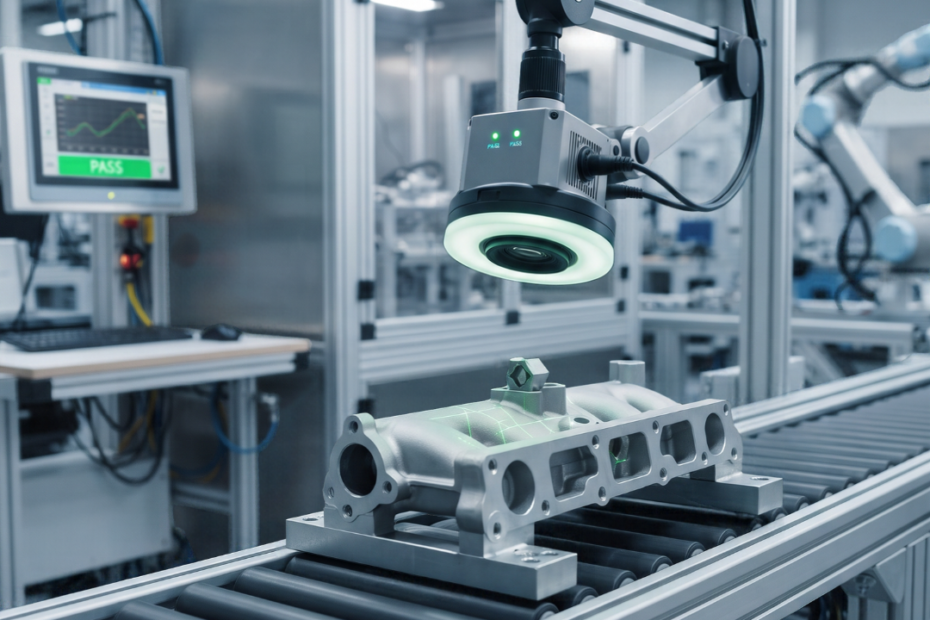
On a high-speed production line, manual errors—a missed screw, an incorrect component sequence, or a skipped test parameter—directly translate into costly scrap, rework, and field failures. Traditional inspection only catches defects after they are produced. Poka yoke (mistake-proofing) changes the process architecture so that a defective action either becomes mechanically impossible or is intercepted instantly at the workstation.
Modern industrial automation has shifted mistake-proofing from basic mechanical jigs to intelligent sensors, PLCs, vision systems, and automated data acquisition (DAQ) environments. Here are 10 practical poka yoke examples deployed across modern manufacturing floors to reduce defects.
10 Poka-Yoke Examples in Manufacturing
1. Asymmetric Fixtures & Mechanical Guide Pins
- The Problem: Operators loading components upside down or misoriented, leading to structural jams or downstream failures.
- The Poka Yoke Fix: Design assembly fixtures with asymmetrical guide pins, keyed slots, or unique geometric profiles. If the component orientation is incorrect, the part will physically refuse to seat, halting assembly before it begins.
2. Proximity & Part-Presence Sensors
- The Problem: Operators occasionally miss sub-components like small washers, O-rings, clips, or thermal pads during manual assembly.
- The Poka Yoke Fix: Integrate inductive, capacitive, or photoelectric sensors into the nest. If the sensor fails to verify the presence of the sub-component, the PLC locks out the cycle, preventing the press or fastener tool from firing.
3. Error-Proofing Fastener Counts with Smart Screwdrivers
- The Problem: An assembly requires a precise pattern (e.g., 6 mounting screws), but operators occasionally miss one due to fatigue or line pacing.
- The Poka-Yoke Fix: Use smart electric nutrunners paired with counting controllers or kit trays. The workstation PLC tracks each successful tightening cycle and will not release the unit or unlock the nest until the exact required fastener count is reached.
4. PLC-Enforced Process Sequence Interlocks
- The Problem: Technicians executing process steps out of order—such as torqueing before proper alignment or testing before complete assembly.
- The Poka Yoke Fix: Implement sequential interlocks via a PLC. Step 2 programmatically remains disabled until sensors confirm that Step 1 has been executed and verified. Operators cannot bypass or jump steps.
5. Closed-Loop Torque and Angle Monitoring
- The Problem: A fastener is under-tightened, stripped, cross-threaded, or missed entirely. Visually, the bolt head looks fine from the outside.
- The Poka Yoke Fix: Deploy intelligent DC tightening tools that measure both torque and rotational angle in real-time. If parameters deviate even slightly from the preset window, the controller triggers an immediate line-stop and flags the part as a reject.
6. Automated Machine Vision Inspection
- The Problem: Human visual inspection is prone to fatigue, leading to missed scratches, skewed labels, incorrect component variants, or surface defects.
- The Poka Yoke Fix: Integrate high-resolution industrial cameras with machine vision software. The system inspects 100% of units against strict digital templates at line speed, automatically diverting rejects to a bin without operator intervention.
7. Barcode / QR-Driven Model Verification
- The Problem: Mixed-model assembly lines suffer from the wrong variant, sub-assembly, or label being applied to a specific job order.
- The Poka Yoke Fix: Mandate a barcode or QR code scan of the raw part and work order prior to station activation. If the scanned component does not match the bill-of-materials (BOM) for that station, the controller keeps the process locked and creates an audit trail.
8. Shadow Boards and Tool Interlock Trays
- The Problem: Operators picking the wrong tool grade, torque wrench setting, or misplacing critical hand tools inside assemblies.
- The Poka Yoke Fix: Use optical shadow boards or sensor-embedded tool cradles. If a tool is missing from its designated slot or the wrong tool is picked up for a specific product variant, the station inhibits operation.
9. Automated Pass/Fail DAQ Test Stations
- The Problem: End-of-line testing relying on operators reading analog/digital gauges manually, leading to human error, wrongly recorded readings, or missed limits during peak hours.
- The Poka-Yoke Fix: Replace manual meter reading with automated Data Acquisition (DAQ) systems and specialized test software (such as LabVIEW-based test rigs). The system directly excites the unit, measures electrical/mechanical parameters, applies hard software limits, and logs timestamped data with minimal manual effort.
10. Database-Linked Pass-Record Verification Before Packing
- The Problem: A defective or untested unit bypasses the test loop and gets boxed for dispatch because manual tracking failed.
- The Poka Yoke Fix: Install a barcode scanner at the packaging station linked to the production database. The packing printer or conveyor gate will only release if the unit’s serial number carries a verified, uncompromised “PASS” status from the test station.
Deploying Poka Yoke via Automated Test Architecture
To maximize efficiency, modern test and assembly cells integrate poka-yoke directly into the software and control layers:
- Automatic Program Switching: Scanning a unit barcode automatically loads the correct test sequence, eliminating operator setup errors.
- Enforced Test Limits: Calibration parameters and test thresholds are locked within the software, preventing manual tampering.
- Complete Traceability: Every test result, torque value, and sensor confirmation is auto-saved with a timestamp for deep root-cause analytics.
Frequently Asked Questions
Poka-yoke is a Japanese term for mistake-proofing. It means adding a simple feature, device or check to a process so that an error either cannot happen or is caught immediately, before it becomes a defect.
Poka-yoke is not an abbreviation, so it has no full form. It is a Japanese phrase: “poka” means an accidental mistake and “yoke” means to avoid.
There are three main types: the contact method (uses shape, size or colour of the part), the fixed-value method (checks that a set number of parts or actions is done), and the motion-step method (checks that steps happen in the right order).
Inspection finds a defect after it has been made. Poka-yoke prevents the error, or catches it at the moment it happens, so fewer defective units are made in the first place.
No. Many ideas, such as fixtures, colour coding and tool trays, cost very little. Small and medium manufacturers can start with these and add sensors, vision and automated testing later.
Conclusion: How Puja Controls Can Help
Effective mistake-proofing bridges mechanical design, sensor integration, and intelligent software control. At Puja Controls, we specialize in designing and deploying custom automated test equipment, data acquisition systems, vision inspection setups, and LabVIEW-based automation solutions tailored for industrial shop floors.
If your facility struggles with recurring bottlenecks, manual errors or rework, talk to our team and we will help you find the right solution.