
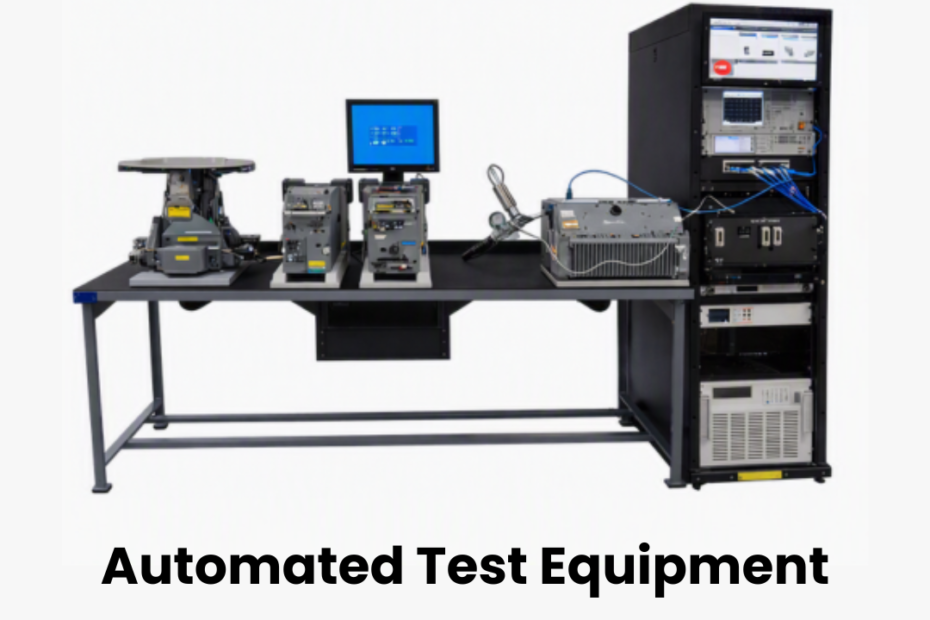
Most explanations of automated test equipment (ATE) — also called automatic test equipment, the two terms mean the same thing — stop at one line: hardware and software systems that test parts, devices, or machines automatically, without someone doing each check by hand.
That line is correct. It also doesn’t explain the thing that actually matters.
Here’s the real question: why do two ATE systems, built with almost the same instruments and the same budget, turn out so differently? One runs for ten years with barely any trouble. The other starts giving false failures and random breakdowns within its first year — sometimes its first month.
The answer is almost never the hardware. It’s the software layer that connects everything together, and how carefully that layer was built.
What Automated Test Equipment Actually Needs to Do
Strip away the technical jargon, and every ATE system — whether it’s testing a semiconductor, a cable, a circuit board, or a finished machine part — exists to answer one simple question, again and again, without ever drifting: does this unit meet spec?
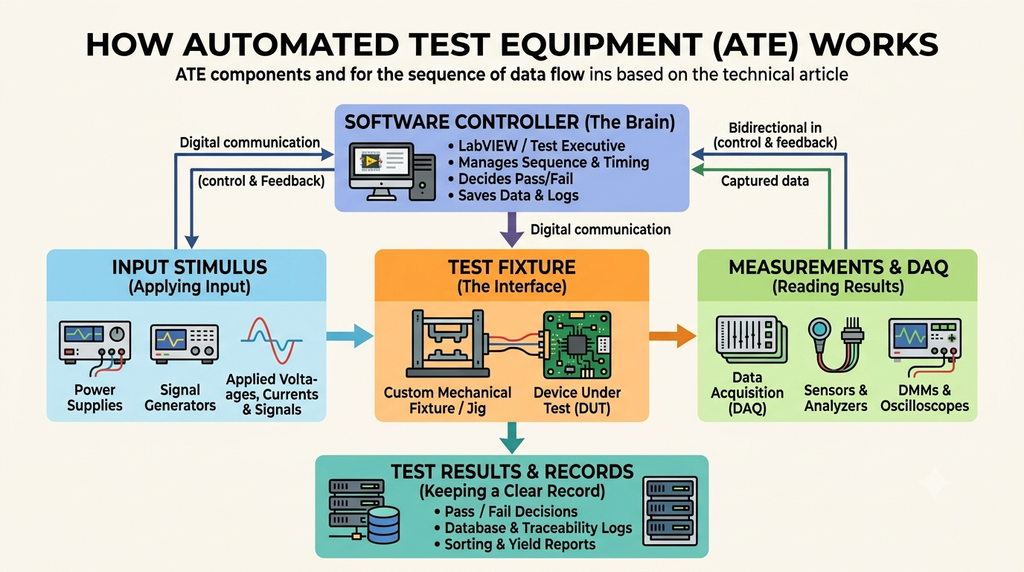
Answering that question reliably, at real production speed, means handling a few different jobs at once:
Applying the right input. Voltage, current, a signal, or some kind of movement — whatever the part being tested needs, often at several different points or conditions, not just one ideal case.
Reading and understanding the results. Taking sensor data or instrument output and doing it fast enough, and accurately enough, to catch real problems — without flagging good units as bad.
Doing everything in the right order, at the right time. A test that runs steps out of order, or reads a value too early before it’s settled, gives results nobody can trust — even if every instrument is working perfectly. This is often where “random” test failures actually come from.
Keeping a clear record. Every pass or fail result needs to be tied back to the exact unit, time, and test setup. This matters a lot the moment something goes wrong and needs to be traced back to its cause.
Picking the right power supply, right DAQ hardware, and right fixture is the easier part — that’s well understood, and most instrument suppliers can guide you through it. The harder part, the one that decides whether the system is still trusted two years later, is the software that ties it all together.
The Mistake That Causes the Most Rework
The complaint we hear most often sounds like this: “Our ATE system worked fine during testing. It’s been unreliable ever since it went onto the production floor.”
In almost every case, the hardware wasn’t actually the problem. The system had been checked under easy, low-volume conditions — a few sample units, an engineer standing by to fix anything odd. The software underneath was never built to handle real production: shift changes, temperature swings, slight differences between units, and thousands of test runs instead of a handful.
Before: A system is built and tested on the bench. It works fine on a small batch. Once it moves to the production line, small problems start showing up — a good unit gets marked “failed,” or the system randomly freezes mid-test and needs a manual restart. Nobody can reliably reproduce the issue, because it only shows up under real production speed and conditions. The team starts checking hardware that was never actually broken.
After: Same instruments, but the software was built with real production in mind from day one — proper wait times built in instead of assumed, error-handling for the unexpected instead of assuming every reading will be clean, and enough detail logged on every test to actually track down a problem when one shows up. This system behaves the same way on unit one and unit one lakh — at 3 AM on the night shift, or at 10 AM with an engineer standing right there.
The instruments could be identical in both cases. The difference is entirely in how carefully the software was built.
Three Kinds of Testing, Same Underlying Need for Discipline
Automated test equipment isn’t just one thing — it covers a few different jobs, and it’s worth knowing the difference:
Functional test simply checks if a unit does what it’s supposed to do. This is usually the fastest check, run on every single unit.
Parametric test goes deeper — measuring exact electrical or physical values against tight limits, not just a simple pass or fail. This needs much more precision in both the instruments and the software timing, because the pass/fail line often sits very close to normal measurement noise.
Burn-in / stress test runs units under tougher conditions — longer time, higher heat, repeated cycles — to catch early failures before a unit ships. This depends heavily on the software’s ability to run unattended for hours without quietly failing, since a stress test that silently stops halfway through defeats its own purpose.
Each of these needs something slightly different from the underlying software, which is exactly why a system built casually for one type often struggles when a new requirement pushes it toward another.
Why LabVIEW Is So Common in This Space
This is exactly the kind of problem LabVIEW was built to solve — worth explaining why, rather than just stating it.
An ATE system needs to read from several instruments at once — a power supply here, a sensor there — and make timing-sensitive decisions based on all of it together, without one part blocking another. LabVIEW’s design handles this kind of work more naturally than most general programming approaches, because it was built around exactly this pattern: read, sync, decide, log, repeat.
It also connects directly to NI DAQ, PXI, and CompactRIO hardware, and talks to instruments over GPIB, USB, Ethernet, and serial connections — so the software can communicate with power supplies and analyzers without someone building custom low-level connections for every new instrument.
That said, the software doesn’t build itself. A LabVIEW-based system still needs proper structure underneath — clear separation between hardware control, test logic, and data handling — or it will run into the exact same problems as a system built on any other tool. Choosing the right platform removes one risk. It doesn’t remove the need for careful engineering.
The One Question That Actually Predicts Reliability
Before choosing new automated test equipment, or figuring out why an existing one keeps causing trouble, the most useful question isn’t about instrument specs. It’s this:
Was this system tested under real production conditions — full speed, full shifts, real temperature changes — or only under easy bench conditions with an engineer standing by?
Systems that only pass the second test usually fail the first one — and they tend to fail in expensive, disruptive ways, discovered only after the line is already depending on them.
Frequently Asked Questions
ATE checks the safety, function, and performance of parts and devices automatically. Common uses include end-of-line (EOL) testing in factories, semiconductor testing, automotive part testing, and burn-in testing before shipping.
Nothing — the two terms are used interchangeably across the industry. Both mean the same automated hardware-and-software test systems.
Usually: something to apply input (power supply, signal generator), something to measure results (DAQ, sensors, analyzers), a fixture that holds the part being tested, and software that manages timing, decides pass/fail, and logs results.
No — ATE can be built with different software tools. LabVIEW is popular because it fits well with multi-instrument, timing-sensitive test setups, but good engineering matters more than which tool is used.
Where This Leaves You
Automated test equipment is only as reliable as the software behind it. The instruments matter, but they’re the easier half of the job. The harder half — timing, sequencing, error-handling, and keeping a clear record — is what separates a system trusted for ten years from one that causes constant headaches.
That’s the part worth getting right the first time.
Puja Controls builds LabVIEW-based automated test equipment — functional, parametric, and burn-in — for machine manufacturers, system integrators, automotive OEMs, and industrial equipment manufacturers. If you’re planning new test equipment or trying to figure out why an existing system isn’t holding up, we’re glad to talk it through.